
How to Have a Successful Garage Sale: A Complete Guide
Yardmine
March 7, 2026
So you've finally decided to clear out the garage, the attic, the kids' old room — maybe all three. Good news: a well-run garage sale can put real money in your pocket and free up space you forgot you had. Bad news: a poorly-run one means sitting in your driveway for six hours and making $23.
Let's make sure you end up in the first camp.
Start With a Ruthless Sort
Before you price a single item, you need to decide what's actually going. This is where most people stall — so here's a simple rule: if you haven't used it, worn it, or thought about it in the last year, it goes in the sale pile.
Walk through every room with three bins or areas: sell, donate, and trash. Be honest with yourself. That bread maker from 2019? Sell. The jeans that "might fit again someday"? Sell. Broken furniture you've been meaning to fix for two years? Trash or donate for parts.
A few things that always sell well at garage sales: kids' clothes and toys, kitchen gadgets and small appliances, tools, books, furniture, and seasonal décor. Electronics can be hit or miss — if it still works and you have the charger, price it to move.
Things that almost never sell: old textbooks, VHS tapes (sorry), used mattresses, and anything stained or visibly damaged. Don't put these out — they make the whole sale look sad.
Pick the Right Date
Timing matters more than you'd think. The sweet spot is a Saturday morning in spring or early fall — think April through June or September through October. People are out and about, the weather is cooperating, and the yard sale gods are smiling. (For a deeper dive on timing, check out our guide on the best days and times to hold a yard sale.)
Avoid holiday weekends (everyone's traveling), the dead of summer (too hot to browse), and any weekend with bad weather in the forecast. If rain is likely, have a backup date ready and mention it on your listing.
Starting early is key. Most serious garage sale shoppers — the ones who actually spend money — are out by 7 or 8 AM. We'd recommend 8 AM to 2 PM as your window. By early afternoon, foot traffic drops off hard.
Price Everything (Yes, Everything)
Nothing kills a sale's momentum like a buyer having to ask "how much is this?" for every item. Price stickers on everything. Period.
Here's the general philosophy: price things at 10-30% of what they'd cost new. People are at a garage sale because they want deals. If your prices feel like eBay, they'll walk. (Need help with specific categories? See our full garage sale pricing guide.)
Some quick guidelines:
- Clothing: $1-5 per item. Brand names and like-new stuff toward the high end. Kids' clothes can go for $0.50-2.
- Books: $0.50-1 for paperbacks, $1-3 for hardcovers. Or do a "fill a bag for $5" deal — it moves volume.
- Kitchen stuff: $1-5 for gadgets and utensils, $5-15 for small appliances that work.
- Furniture: 20-30% of retail if it's in good shape. Be willing to negotiate — people expect to haggle on big items.
- Electronics: Price low and be upfront about condition. A working Bluetooth speaker for $5 will sell instantly. A "might need a new cord" laptop for $50 will sit there all day.
- Toys and games: $1-5. If all the pieces are there, say so on the price tag — that's a selling point.
Pro tip: use colored dot stickers for price tiers. All green dots are $1, blue dots are $5, red dots are $10. It's faster than writing individual prices and makes checkout easy.
Make Your Sale Easy to Find
This is the part people underestimate. You could have the best stuff in the neighborhood, but if nobody knows about it, you'll be sitting alone with your lawn chair and a box of old DVDs.
Online listings are a must. Post your sale on Yardmine with photos, your address, date, and time. Buyers use map-based apps to plan their weekend route, and if your sale isn't on the map, you're invisible to the most motivated shoppers.
Beyond online listings:
- Signs at nearby intersections. Big, readable text. Just the essentials: GARAGE SALE, an arrow, and the address. Don't try to list everything on the sign — people are driving past at 30 mph.
- Post on your local neighborhood Facebook groups and Nextdoor. Include 2-3 photos of your best items to get people excited.
- Tell your neighbors. They might want to do a multi-family sale, which draws way more traffic than a single-household one.
Put your signs out the morning of the sale (or the night before if your neighborhood allows it) and — this is important — take them down when you're done. Nothing annoys a neighborhood faster than stale garage sale signs stapled to every telephone pole.
Set Up Like You Mean It
Presentation matters. A garage sale that looks organized and inviting will outsell a cluttered mess every time, even with the exact same inventory.
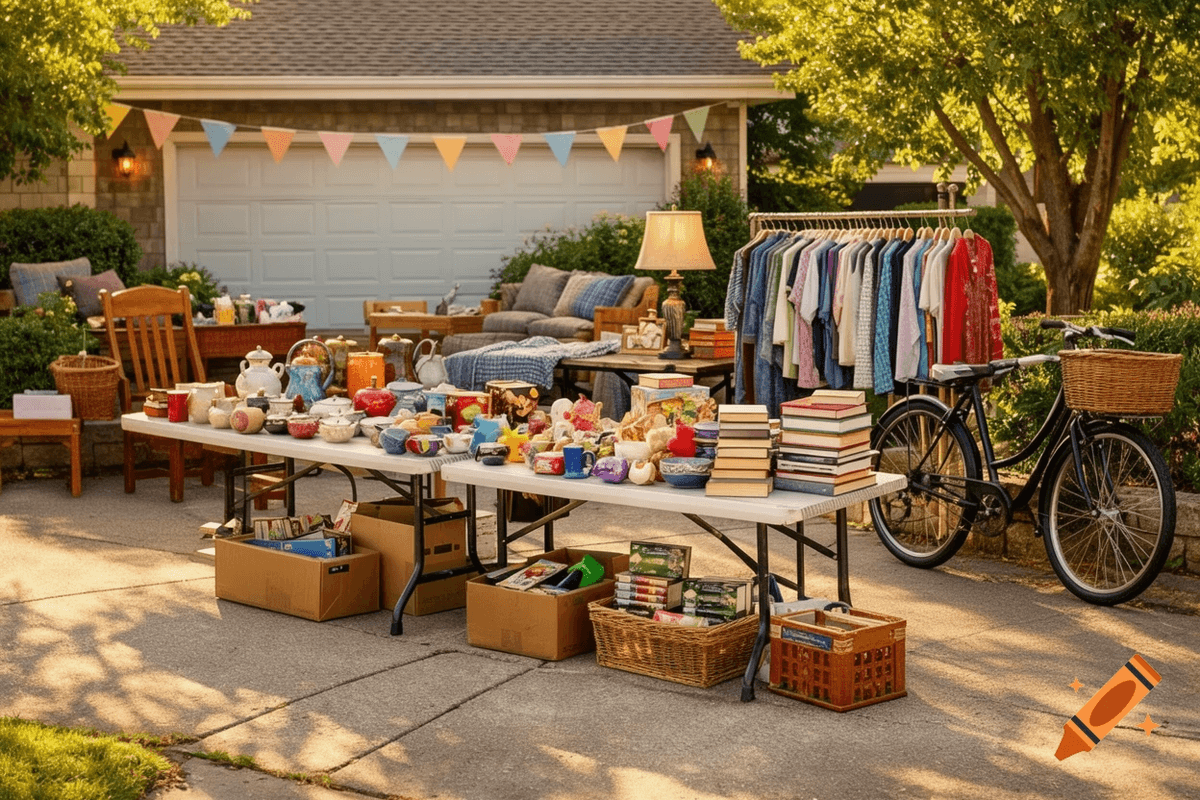
Tables are essential. Borrow folding tables, use sawhorses with plywood, whatever you've got. Items displayed at waist height sell better than items sitting on the ground or on a tarp. It feels more like shopping and less like picking through a pile.
Group similar items together: all the kitchen stuff in one area, clothes in another, books on their own table. Hang clothes on a rack if you have one — folded clothes on a table get ignored because people don't want to unfold and refold everything.
Make it browsable. Leave space between tables so people can walk through comfortably. If your driveway feels crowded, you'll lose the "I'm just looking" shoppers who might have found something if they'd stayed another minute.
A few more setup tips:
- Put your eye-catching items at the front — the vintage lamp, the nice bike, the big-ticket furniture. These are what pull people in from the street.
- Have a "FREE" box near the curb. Old magazines, kids' happy meal toys, whatever. It gets people to stop, and once they stop, they browse.
- Set up a checkout area with a cash box, bags, and newspaper for wrapping fragile items. Speaking of cash...
Be Ready for Money
Have change ready. Start with at least $50-75 in small bills and coins. You will absolutely get someone handing you a $20 for a $2 item at 8:01 AM. It happens every time.
Breakdown that works: ten $1 bills, four $5 bills, and $5-10 in quarters.
Accept digital payments if you can. Venmo, Zelle, Cash App, Apple Pay — whatever's easy for you. A lot of people don't carry cash anymore, and you don't want to lose a $30 furniture sale because someone only has a card. A simple handwritten sign that says "We accept Venmo!" works fine.
Keep your cash box close and ideally attended at all times. Most garage sale shoppers are lovely people, but a visible pile of money in an unattended box is tempting for anyone.
Negotiate Like a Human
Haggling is part of the deal. Expect it, embrace it, and don't take it personally.
A good rule of thumb: be willing to come down 20-30% on most items. If something is priced at $10 and someone offers $7, just take it. You were going to donate it anyway, and $7 is $7.
Where it makes sense to hold firm: items you know are worth what you're asking (brand name tools, quality furniture, collectibles you've priced fairly). A quick "I've seen these go for more on eBay, so I think $15 is pretty fair" usually works.
In the last hour of your sale, drop prices aggressively. Anything left over is going to Goodwill anyway. A "half off everything" announcement at 1 PM can spark a final rush.
The Last Hour: Close It Out
When things wind down:
- Box up anything decent that didn't sell and donate it. Most thrift stores will take it, and some (like Habitat for Humanity ReStore) will even pick up furniture.
- Take down your signs. All of them. Seriously.
- Remove your online listings so people don't show up to your house next weekend.
- Count your earnings and celebrate. Even if it's not life-changing money, you decluttered your home and got paid for it. That's a win.
Quick Checklist
- Sort items into sell, donate, and trash piles
- Price everything with stickers or color-coded dots
- Pick a Saturday morning in spring or fall
- List your sale on Yardmine with photos
- Post to Facebook groups and Nextdoor
- Make signs for nearby intersections
- Set up tables, group items, and stage the best stuff up front
- Prepare $50-75 in small bills and coins
- Set up Venmo/Zelle/Cash App for digital payments
- Put out a FREE box near the curb
- Have bags, newspaper, and a cash box at checkout
- Drop prices in the last hour
- Donate leftovers, take down signs, and remove online listings
Ready to list your sale? Create a free listing on Yardmine and get your sale on the map in under 5 minutes.
Ready to host your own sale?
List for free and reach local shoppers.